
Tripods: Part Two - Heads
Since we’ve covered the topic of what to look for when choosing tripod legs (along with some recommendations), we should logically cover the other half of that equation: a good tripod head. Choosing a head is quite a bit less complicated – you’ll know what kind you’re looking for and either they do the job or they don’t – but also somewhat frustrating because it’s practically impossible to gauge the actual quality until you use it yourself. It also depends on how strict your tolerances are; reading user reviews is probably the best way to narrow down potential purchases because sheer specs won’t tell you much.
Again, I need to apologize for the lack of product photos in this. Due to a combination of COVID-19 and dealing with my late uncle’s estate, I am not (and have not been) home in Tennessee for a while, so I do not have a lot of my gear with me here in Ohio.
Since we’ve covered the topic of what to look for when choosing tripod legs (along with some recommendations), we should logically cover the other half of that equation: a good tripod head. Choosing a head is quite a bit less complicated – you’ll know what kind you’re looking for and either they do the job or they don’t – but also somewhat frustrating because it’s practically impossible to gauge the actual quality until you use it yourself. It also depends on how strict your tolerances are; reading user reviews is probably the best way to narrow down potential purchases because sheer specs won’t tell you much.
There are far fewer variables when it comes to a head than the legs; the materials used isn’t typically a concern, you don’t have to worry about things like the number of leg sections, etc. A good head is one that allows you to do the job in the simplest, smoothest, and most stable way possible – if you don’t intend to take panoramic photos, you can easily rule out a specialized panoramic head. If your camera system is a tiny micro 4/3 mirrorless, you probably won’t need an Arca Swiss Cube.
So, I’ll just cover a few important points and then some suggestions. Again, these suggestions are only based on what I’ve used, which means equipment that I have no (or little) use for isn’t in the mix – for example, I don’t need a special head for panoramic or time lapse photography. If that’s what you need, you probably won’t find this very helpful.
First, determine what KIND of head you need. There are four primary types of heads: ball, geared (sometimes called pan & tilt), gimbal, and pistol grip. I don’t use gimbal heads, so we won’t get into that one. Avoid pistol grip heads; they seem appealing and cool, but I’ve never used one that could lock down with remotely decent accuracy. This leaves ball heads and geared heads – both are different enough and with their own advantages that you may want one of each. I’ll go into the differences and strengths of each shortly.
Determine your weight requirements: both load capacity and weight of the head itself. If you want a general head for a wide range of applications, you likely want something smaller and lighter. If you have a massive camera setup and/or you mostly stay in the studio, then the weight of a heavier head won’t be an issue.
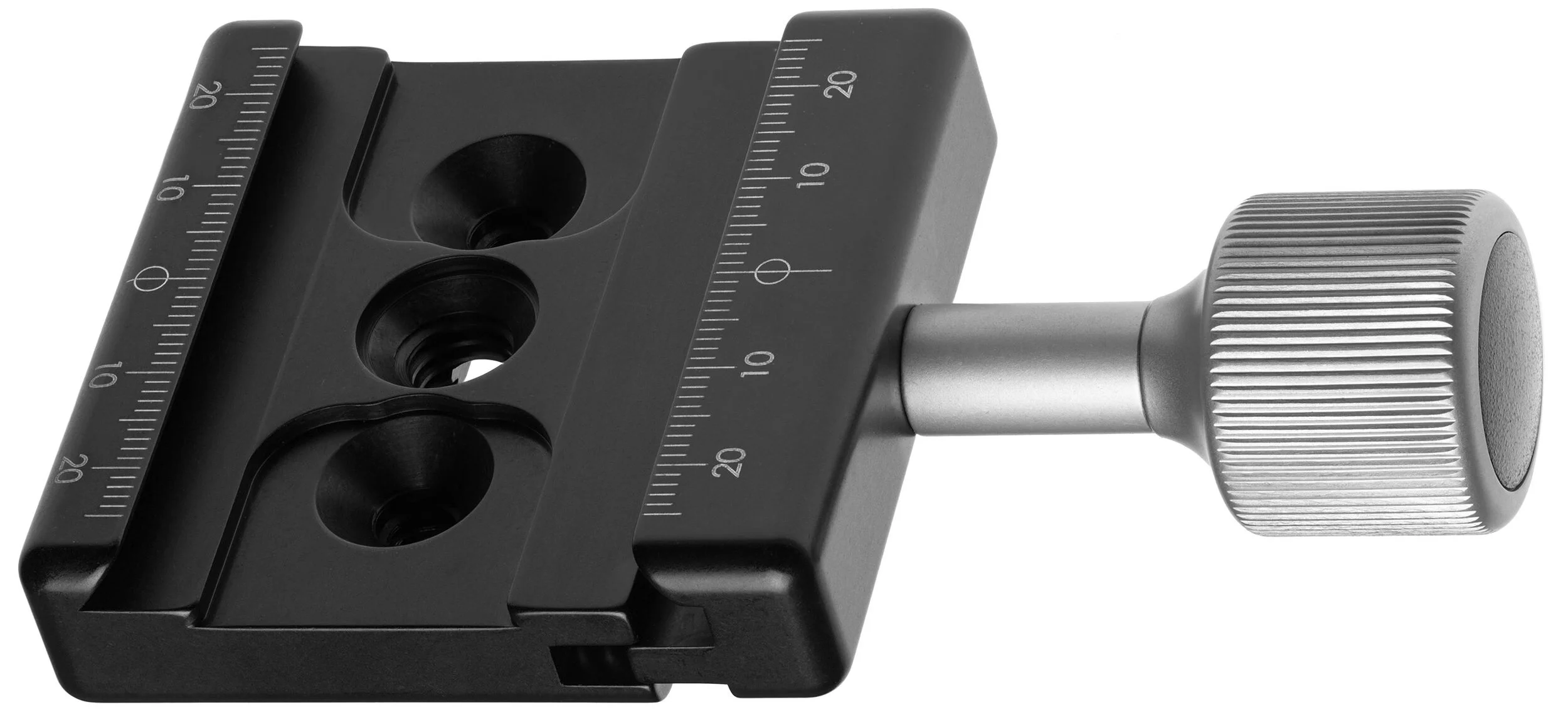
Arca Swiss compatible* or not? Heads will typically either have a proprietary QR connection or they will employ the classic Arca Swiss quick release clamp. The Arca Swiss QR is always my preference – it’s quick, simple, standardized, and with an Arca Swiss L-bracket it makes shooting in both orientations very simple. If this doesn’t matter to you one way or the other, then don’t worry about it. But be sure to check if the head comes with a plate (whether it’s Arca or not); if not, make sure to get one (factor this into the cost as well).
Arca Swiss clamp plate. Camera plate/bracket slides in and is locked in place by tightening the knob.
(Image from Wikipedia, Creative Commons license)
*For those who don’t know what a head with an Arca Swiss quick release means: Arca Swiss is a French manufacturer known primarily for their top-of-the-line large format view cameras, which are designed to integrate with digital backs or even DSLRs/MILCs. Outside of this ultra-niche high-end market, they’re best known for their “Arca Swiss Quick Release System” developed in the 1990s and has now essentially become a standard – and for good reason. An Arca QR base plate is a 35mm wide (length can vary) CNC machined component with a 45º degree dovetail and usually a standard 1/4-20 (some are 3/8) screw. The other part of the QR system is the clamp on the head, which allows the base plate to be slid in from either side – once it has been inserted, the clamp is then tightened usually via a simple twist knob (sometimes a flip lock). It’s incredibly simple, especially because it does not matter what direction or orientation you insert the base plate – it’s completely identical on each side. Most other manufacturers’ proprietary systems require a special orientation to mount and unmount the camera. Arca Swiss QR bases can come as a simple universal plate with rubberized grip, as a universal L-bracket, or – and this is the best part – a base plate or L-bracket designed specifically for your model of camera. This ensures that the camera or plate have absolutely no room to flex or shift. They’re also far nicer if you hate removing/attaching tripod plates constantly – most other systems are awkward and unpleasant when attached to a camera, but Arca Swiss plates don’t hinder your comfort or ability to handhold the camera – an L bracket can even make for a decent sort of left-handed grip.
Ball vs. Geared. This is an obvious extension of the first note. Ball heads are fairly basic; usually the camera mount (QR plate connection) is positioned on a “neck” which is linked to a ball joint – this is fitted inside the socket of the main “body” (which screws directly to the tripod) and allows you to swivel, pan, tilt, angle, etc. in pretty much any direction very quickly. A knob is then tightened to lock down the head once you have positioned your frame. The Arca Swiss p0 uses an inverted design – the camera mounts to the main body of the head, which then pivots atop the neck. It also uses a knurled ring to lock the head down, rather than a knob. But the general idea remains the same in either.
Geared heads operate completely differently. While the actual design can vary quite a lot from model to model, the basic function of a geared head is the use of multiple independent locking mechanisms. Unlike a ball head, which has a single lock and moves freely in all directions when unlocked, a geared head will only move along the axis that is unlocked. This allows for precise positioning and fine-tuned adjustments without disturbing the other movements. Conversely, it also makes it slower to deploy and use, since each direction of movement must be locked/unlocked independently. Geared heads usually have markings to indicate angle and position; ball heads won’t have these markings, though they usually have markings around the 360 degree pan rotation at the base.
Because of the simpler design and lack of multiple locks/handles, ball heads can be considerably smaller in packing volume than geared heads and a bit lighter in weight, though exceptions exist on both ends of course.
For me? I like ball heads for travel and in the field – they’re smaller to pack and quicker to deploy in use. Geared heads are great for studio and macro photography – “no rush” photography that may also require precise adjustments, which product and macro work certainly does.
Now, onto the difficult part. Finding a head that works and works well. This entirely depends on your tolerances – mine are extremely tight and not very forgiving. I’ve gone through maybe a dozen and a half heads, testing and usually returning if there were any obvious problems (I typically buy used or openbox from Adorama as I do not care for returning brand new merchandise unless there is an actual problem with it or it’s just total garbage; Open box items are also cheaper while still retaining full manufacturer warranty).
The most typical problem is the dreaded droop – minor downward movement of the frame after locking the head. Even with perfect locking technique (there is such a thing, believe it or not) this is often unavoidable entirely with a majority of heads – particularly ball heads. Droop becomes a bigger issue at higher magnifications or with tighter framing (i.e. macro or telephoto work) and/or with more weight – thankfully the latter has become less of an issue with the mirrorless revolution.
My work demands are such that I essentially cannot tolerate any droop at all. This was very frustrating for a long time because I never thought I’d find a ball head that perfectly locked down, but alas… I did. Actually, I found two.
Manfrotto Hydrostatic Ball Head (468MG) (~$280)
The first ball head I ever found that locked securely in place with no droop – seemingly without regard to the amount of weight to boot. This head differs from others in that it uses a unique vacuum chamber and pressurized hydraulic lock to secure the ball and joint. The large size of the side knob along with its rubber-textured surface make it incredibly easy to gently but securely lock the head without inducing unwanted movement. On the opposite side of the head is the standard knob lock that allows you to pan the head.
There are several variants of this head – the base 468MG, one with an RC2 QR plate, one with an RC4 QR plate, and one with an MSQ6PL QR plate. I have the latter, but as far as I know, all are the same quality head.
See here at Amazon and Adorama.
Arca Swiss Monoball p0 Ball Head (~$300-450)
Arca Swiss products are notoriously the opposite of cheap, but here is a quite affordable though absolutely top-of-the-line tripod head that comes in right around the same price as the Manfrotto Hydrostatic (depending on which variant you get of either).
As mentioned before, the p0 differs slightly in construction with the camera attaching directly to the body, inside which is the locking mechanism; most other designs separate these two. The upshot is that the locking mechanics are closer to the camera and the camera can rotate nearer to the ball (and therefore nearer to the center of gravity). It also means that you needn’t worry about leveling the base of the structure for panoramas or other stitching: the panning system is linked directly to the camera body.
The knurled ring that locks/unlocks the head is also very nice – I prefer it to the side knob of other designs because a) you don’t have to fumble around for it or worry about its positioning, b) it locks down with significantly more ease - I think this is a combination of both the design* and being a ring vs. knob.
*The locking ring has very little travel compared to what you’d expect from using other heads. When fully unlocked (it has hard stops, at least at the unlocked end) it takes only a few degrees of a turn to significantly tighten the head (but not totally) and only a bit more to totally and completely lock it. And it LOCKS - I’ve tried with all my might to move it with my hand and I simply cannot. A camera won’t even phase it.
Like the Hydrostatic, there are a few variants: the base with no plate connection, the Slidefix QS release, and the classic Arca Swiss QR release. I got the base with no clamp because it’s $70 cheaper than the Classic QR version and you can add a decent clamp of your choice for $20-30 or a nicer one for $50-120. I like the Feisol QRC-50 or one of the Really Right Stuff B2 variants with a dab of non-permanent Loctite (note: do NOT let the Loctite get onto the nut around the 1/4” screw on the head - that nut must be able to move to pan the head).
This is simply the best ball head money can buy below $500. I’d definitely recommend the p0 over the Hydrostatic, but you can’t go wrong with either – ultimately, it’ll probably come down to your preferences in the design, differences in price, and/or availability in your region. At roughly $300 for the base version, it isn’t necessarily cheap, but considering the quality, it’s truly impossible to be disappointed with it. Just a fantastic piece of engineering and one of my favorite gear investments; it’s basically permanently welded onto my Gitzo Traveler.
It’s worth mentioning the Manfrottos have warranties extendable to ten years, whereas the p0 has “only” a three year warranty (Adorama claims 5, they are wrong).
See here at Amazon and Adorama.
Gitzo GH2750 Series 2 Off Center Ball Head (~$275)
This was a very recent purchase and, somehow, I ended up incredibly lucky. I needed a second head and since I’m out of town, ordering one was my only option. I looked at a lot of options – considered a second p0 or Hydrostatic Head – and decided that if I’m going to spend a couple hundred bucks, I might as well get one that does something my other gear doesn’t. Lots of searching and pondering later, I came across a Gitzo GH2750 off center head, brand new and sold by Amazon, for $118. That was less than half the price I saw it listed anywhere else, even used on eBay. Since Amazon returns are simple and painless, there really wasn’t any risk in grabbing it up.
And I’m very pleased I did. Not only did I get a brand-new ball head that I can later sell at a profit, but this one does have some unique features that none of my others do – chiefly, the “off center” part of its name. The result is a head that can pivot and turn in literally any direction and assume any orientation without interference from other parts of the head. Not only does the neck pivot on the ball, but the housing of the ball can turn 360 degrees. This means you can achieve virtually any angle or framing you want without the need for an L-bracket. I wouldn’t use it this way with a huge medium-format camera unless you have a heavy, rock-steady tripod, but for regular mirrorless and DSLR cameras, it’s wonderful.
The head also locks down tight and exhibits no droop – at least none that I have noticed so far. The only niggle is that it doesn’t lock quite as easily as the Hydrostatic or p0; the knob requires more distance and torque compared to the others, which seemingly locks down with very little effort. The upshot of this is that you need to be careful to not knock your framing off when tightening the locking knob.
It also does not have any kind of built-in quick release, so you have to add your own (see above about the p0 for recommendations).
See here at Amazon and Adorama.
Sirui FD-01 Four-Way Geared Head (~$229)
Coming in at just $229, this geared head is surprisingly good. With an integrated Arca-type clamp, the FD-01 has four points of adjustability controlled by two knob locks and two handle-locks. One handle controls lateral movement and the other controls the vertical. Each of the knob locks control a 360 degree panning function – one at the base of the unit where it attaches to the legs and one at the top directly beneath the camera mount. The two separate panning systems allow greater flexibility and control for stitching and panoramas.
The head is an all-aluminum construction weighing in at 1.7 pounds with a rated load capacity of 22.1 pounds. I’ve only used this head with smaller gear (usually micro 4/3, occasionally FF mirrorless), so I have no experience with a large DSLR setup on it. But for the lighter-weight work, it is very sturdy and smooth in operation; you have to be gentle when locking the handles so you don’t shift the frame, but that is standard with any of the smaller geared heads.
With a six-year warranty and seemingly excellent construction, there isn’t much to complain about at this price if you aren’t planning to stick a monster setup on top of it. The head finely handles macro work with, for example, an Olympus E-M1 Mark II, Olympus 60/2.8, and accompanying flash trigger. If you have a DSLR + 85mm PC-E (for example), I’d look at something a bit higher end, like the next two recommendations.
See here at Amazon and Adorama.
Arca Swiss d4 Geared Head (~$849-$1169)
Jumping up quite a lot in price, we get to the impressive (though not cheap) Arca Swiss d4 which is essentially a hybrid head of sorts that combines the quick-deployment advantages of a ball head with the precision controls and adjustment capability of a geared head. With the horizontal and vertical axes unlocked, you can freely move the camera about like a ball head – however unlike a ball head, you can independently lock each one and operate as a geared head.
This is the pinnacle of small, lightweight tripod heads in every way. Weighing only 1.8 pounds, it has a rated load capacity of 75 pounds, and I wouldn’t bet against it. There are several variants – the Classic Arca, the Fliplock lever, and the monoballFix – the latter of which is several hundred dollars cheaper than the others and is my recommendation (along with an accompanying monoballFix plate) for that reason alone.
This is my primary head in the studio, supplanting the beautiful C1 Cube. Once I switched mostly to mirrorless for product/macro work*, I had to face the fact that the d4 is absolutely more than enough for any of my needs in the studio. The Cube is an insanely brilliant piece of engineering, and if you need all of what it offers then there isn’t a substitute – but otherwise you’re better off with the smaller, lighter, cheaper, and more flexible d4. Even with a moderately hefty DSLR setup, you’ll probably find your needs served by the d4 – it can certainly hold the weight.
*If you’re wondering why I use a Z6 over the D810 for product, it’s because a) the massive benefits of live-view and a tilt screen; especially with a lens like the 85 PC-E (or any tilt-shift lens), which you can now use handheld and see the true adjusted focus plane and/or shift in live-view which is a notorious issue when using an OVF, b) IBIS - and the tilt screen - allows me to do a decent amount of my work handheld, which was certainly never the case with the DSLRs - plus live-view has PDAF, and c) the lower density sensor permits roughly one more stop down for extended depth of field before diffraction kicks in. Plus, I almost never need 36MP product photos. The D810 still remains as a brilliant landscape tool - ISO 64 and incredible highlight headroom are not insignificant; also, the DSLRs are still superior for wildlife (and long lenses) as well as tracking AF.
The p0 is still used for most of my outdoor/travel work since it’s about a pound lighter and less packing volume than the d4 – it’s also nice to have a head basically welded to my Gitzo Traveler, ready to pick up and go, and one that stays behind on the larger tripods. I’m not a fan of constantly swapping out gear.
See here at Amazon and Adorama.
I won’t get too much into the Arca Swiss C1 Cube – it exists in a rather binary realm where you either need what it offers or you don’t. It’s large, bulky, expensive, and slower to use compared to other options; buy the d4 or something cheaper unless you need what the Cube offers. If you do, you’ll know it, and there isn’t anything better. I loved it, but found the flexibility of the d4 to outweigh the few benefits of the Cube (for me) and certainly couldn’t justify both. See here at Amazon and Adorama.
Tripods: Part One - Legs
You've probably heard it before (for good reason): a good tripod is one of the most valuable investments you can make as a photographer (and videographer, though for often very different reasons). Conversely, one of the worst investments you can make is in a mediocre or straight-up bad tripod. If you skimp on the support, you might as well tack on the cost of those useless legs to the price you tried to avoid paying for one that does its job. Not to mention the headaches you’ll encounter wondering why your photographs haven’t improved.
I’ve used a lot of tripods over the years. Like most photographers, I started out with a cheap $50 (including the head) piece of garbage under the false assumption that all tripods are basically the same (I mean, they just hold your camera and not move, right?). Here I’ll go over a few of the things to look for….
Firstly, I need to apologize for the lack of product photos in this. Due to a combination of coronavirus lockdown and dealing with my late uncle’s estate, I am not (and have not been) home in Tennessee for a while, so I do not have a lot of my gear with me here in Ohio.
You've probably heard it before (for good reason): a good tripod is one of the most valuable investments you can make as a photographer (and videographer, though for often very different reasons). Conversely, one of the worst investments you can make is in a mediocre or straight-up bad tripod. If you skimp on the support, you might as well tack on the cost of those useless legs to the price you tried to avoid paying for one that does its job. Not to mention the headaches you’ll encounter wondering why your photographs haven’t improved.
I’ve used a lot of tripods over the years. Like most photographers, I started out with a cheap $50 (including the head) piece of garbage under the false assumption that all tripods are basically the same (I mean, they just hold your camera and not move, right?). Here I’ll go over a few of the things to look for – or avoid – in selecting a tripod as well as a run-down of some good/great options that vary in price, because after all, most of us do have a monetary limit for even the most essential gear – and some people may not use or need tripods often. All of these tripods I either currently own, have owned, or have used for extensive enough periods of time to be confident in recommending them.
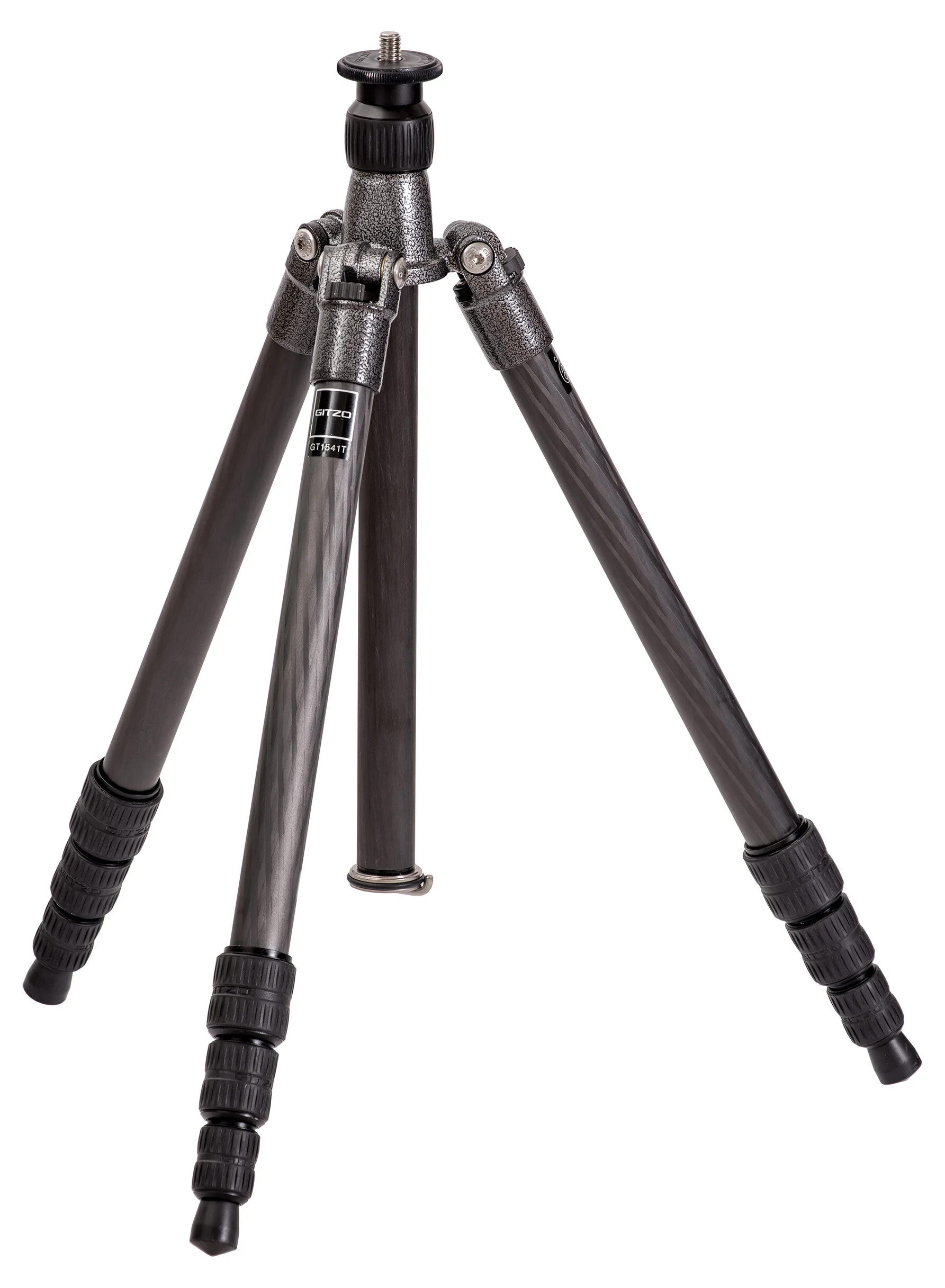
Gitzo Traveler (Image from Wikipedia, Creative Commons)
First, do not buy a tripod that costs less than $100. I draw the limit there only because I have a single example of a decent starter tripod that costs about $110, for those truly on an absolute budget (which, believe me, I certainly understand). If you buy a $75 tripod to save money and then find out its garbage, you’ve done yourself zero fiscal favors.
Do not buy a tripod with a non-detachable head. This speaks for itself. Just don’t do it. They’re trash.
Avoid tripod kits (legs + head). This especially includes camera kits that come with tripods, as those are always total junk*. But, more specifically, tripod kits that are sold with legs and a head are usually not optimal. For one, I prefer the latitude of choosing the best legs for my needs and the best head, instead of having that duo chosen for me. And you’re probably not going to want to spend extra money on a legs/head combo if you’ll end up replacing one. Many of the Gitzo head/leg combos are very good and more than sufficient for 99% of photographers, largely because Gitzo makes quality products. Their ball heads are not my first choice, but they are still excellent options for most (caveat here being that I obviously have not used every Gitzo product, but of the fair number I have used, none have done me wrong).
*Some camera kits come with Joby Gorillapods and while these are quite inadequate for most uses, they have their place. They should never be your primary gear, however. I like them for their incredible versatility when used with phones/compacts/extremely light-weight mirrorless.
Aluminum vs. Carbon Fiber. We’re going to leave niche materials like wood and basalt* out of this. A significant majority of what you see online or in stores will be aluminum or carbon fiber. The most apparent difference is that aluminum is cheaper and carbon fiber is more expensive. Most sites and reviews give weight as the primary advantage for carbon fiber, but this is a woefully insufficient understanding of its practical benefits.
*Basalt is a fiber extremely similar to fiberglass and primarily used in textiles, particularly flame-retardant fabrics for automobiles/racing and aerospace engineering. Basalt is derived from volcanic rock – more specifically, silica. It just so happens that fiberglass is also made of silica. There are some underlying differences in physical properties, but outwardly basalt is black in appearance and fiberglass is white (technically clear, but appears white). Basalt tripods were, I believe, first developed (and now discontinued) by Gitzo, riding a wave of marketing buzzwords that sound nice but offer no benefits over existing materials.
Carbon fiber is quite literally what it sounds like: thin fibers of organized carbon atoms. These fibers are bonded together with a thermosetting polymer and then cross-woven and molded to form the tripod legs. It is not unlike basalt or fiberglass in this regard, though displays higher rigidity, tensile strength, and less thermal expansion. The difference in rigidity is one reason that CF is good for tripods but bad for, say, boats or fishing poles (high rigidity means low flexibility).
For our purposes, the components and manufacturing process of tripod legs make carbon fiber superior over aluminum for a number of reasons:
1) For a given volume, it is lighter in weight.
2) Because of the way carbon atoms are arranged, the fibers themselves have a very high tensile strength (CF has a higher tensile and composite strength than steel, kevlar, titanium, diamond, brass, etc.).* It is the one of the most dynamic and efficient composite materials in the world – about 15-20x stronger than steel if we consider mass equivalence. Carbon fiber is popular in racing vehicles as well as sports cars; it’s often used for body panels and other components to shave weight, though the most impressive utility relates to mechanical components that need to withstand high pressure. CF is often used to replace steel and aluminum drive-shafts because it is lighter, stronger, and safer (if it fails, it simply sheers off into strands, causing no damage to the car or other cars). A CF driveshaft also effectively produces more horsepower and accelerates faster (the driveshaft cannot alter the engine’s output horsepower, but the lower mass and inertia of the carbon fiber shaft effectively and measurably results in higher torque and HP).
*Note that there are many types of carbon fiber, kevlar, steel, etc. There’s UD (unidirectional) carbon fiber, varying binding polymers and processes, different weave patterns, etc; there's carbon steel, alloy steel, stainless, etc. There are also different measurements of strength, e.g. tensile, yield, etc., as well as measurements of elasticity. Thus, the comparisons here are broad and absolutely variable depending on the specifications of the exact material and design used.
3) After being bonded with a polymer, the resulting material can be woven in an orientation that maximizes strength and increases axial capacity.
4) Damping is significantly improved – oscillations are dispersed more efficiently throughout the complex superstructure of fibers, thereby reducing vibration frequency. This may be the most universally valuable distinction between the two materials as it is one of the primary reasons to use a tripod in the first place. Camera manufacturers go to great lengths to minimize shutter shock (EFCS is your friend) and improve mirror damping (in DSLRs), yet those are minor in frequency compared to tripod-induced vibrations.
5) As an extension of #4, carbon fiber “settles” quickly; oscillations are dispersed and the structure returns to equilibrium more efficiently than aluminum. Think of a triangle (the percussion instrument) which emits a sharp, shimmery sound with a lengthy, persistent reverberation. Compare this to a (theoretical) instrument of the same size and shape but made of wood or plastic – hardly any sound at all, let alone reverb. This is partially a combination of damping and a rapid dispersion of amplitude (“settling”).
6) It is more resistant to extreme temperatures – more specifically and importantly, thermal expansion and contraction is greatly reduced. It also does not get noticeably hot or cold to the touch. Note that in extremely cold temperatures, the stiffness of carbon fiber can result in excessive brittleness. This is irrelevant unless you regularly shoot in the Arctic circle.
Not one of my photo-centric tripods is aluminum. All of my video tripods are, but we’ll touch on that at the end. I realize the above is a lot of words and perhaps includes some unnecessary asides, but it should demonstrate – as well as one can without physical experience – why carbon fiber is extremely superior to aluminum, and it is not just about weight (in my opinion, that’s one of its lesser benefits).
Do not believe the stated load capacity. This goes (if not more so) for heads as well. I would say to anticipate a realistic load capacity around 20% of the stated spec. Even that is unreliable as the tripod’s effectiveness is not invariable; it changes based on position of the camera (or lens, if using a collar) and center of gravity, as well as height. The tripod will be most stable with all legs and columns collapsed and least so with all extended, since each deployment of a section introduces a new point of flexibility and each section gets progressively smaller, limiting flexural strength and damping.
Because of these variables, I’m not sure how the load capacity is measured. Ideally, it would be at maximum height as such a measurement is only as good as its weakest point. But, I’m fairly confident this is not how they are (all) measured, especially because….
There is also the matter that every manufacturer clearly differs in how they calculate their specified load capacity. Video tripods (and heads) often have a lower stated capacity than a similar photographic counterpart – even from the same manufacturer – but there’s no doubt which one is sturdier. Three Legged Thing tends to vastly overstate their load spec, while Gitzo is relatively reliable. The Three Legged Thing Leo 2.0 specifies a 66 pound load capacity while my Gitzo GT1545 Traveler indicates 22 pounds. If anything, it is directly the other way around. I wouldn’t use the Leo for anything other than a mirrorless camera and average lens, but I’d comfortably use the Gitzo with a DSLR and large lens.
More leg sections means less stability. See above. For maximum strength, it is better to have a three-section tripod than five. Disadvantage and counterpoint: the collapsed length of the tripod is determinate on the length of the longest leg. This is why travel tripods often have more, but shorter, sections. More sections and reduced length, along with the ability to reversibly fold the legs up and over the head base, allow these tripods to be extremely compact. It’s a tradeoff between stability and weight/size, which is one reason I have more than a single tripod.
Deploy the top-most sections first and avoid extending the center column until necessary. See above again. The top-most sections are thicker, wider, and contain more mass (thereby dispersing oscillations more effectively). And again, each leg extension (or column) introduces new points of flexibility.
Try to get a tripod with a center column hook. A good number of the higher-quality tripods have little hooks (sometimes recessed and spring-loaded, sometimes not) on the bottom end of the center column. These are for hanging weights, usually a sandbag (though you could use a shopping bag full of apples, no one cares), thus reducing the center of gravity and increasing stability. If the tripod does not have this, there are tripod “hammocks” or “aprons” or simply “bags” that fasten to each of the three legs with a pouch suspended in the middle. You can then load these up with rocks, weights, the aforementioned apples, whatever you have available to you. An advantage to these over hook weights is that you can also place accessories or gear in them for quick and easy access. But otherwise the hooks are much more convenient and reliable.
Consider your camera. This may not seem obvious at first, beyond the weight of your body. However, higher-resolution sensors will require greater stability. This is true on or off a tripod. The detrimental effect of angular displacement, whether via hand-shake or tripod vibration, is directly correlated to pixel count per angle of view. It is a rather common misconception that the correlation is to pixel pitch/pixel density, but this is inaccurate. A 20MP Micro 4/3 camera will be less susceptible to vibration-induced pixel blur than a 24MP full frame camera, despite the former having a significantly higher pixel density. This is because, for a fixed angular displacement and angle of view (different focal lengths, of course), the higher MP sensor will displace more pixels per degree. If each camera has a lens providing a 100-degree horizontal field-of-view, a horizontal displacement of one degree will displace an equal number of pixels in a 6000x4000 APS-C sensor as a 6000x4000 FF sensor (60 pixels, in either case).
Consider the type of tripod feet you might need and what options your tripod natively has: Cheaper tripods generally come with simple rubber feet. These may be flat with a pivoting joint, rounded, rounded off to a point, or a number of other designs. Good tripods come with either interchangeable feet, or a rubber foot with a recessed, extending spike should you need to deploy it, or both. Replacement feet can include spikes, suction cups, variously shaped rubber, or clawed shoes for snow, ice, and sand.
Consider the minimum height. Most good photography tripods have a very low minimum height (not true of all video tripods), but there can still be a big difference between 5.5” and 2.3” for some photographers, particularly macro and some landscape.
How do the legs lock/unlock? This may not seem like a big deal and is partially a personal preference. The leg sections will secure via either a flip-lock or a twist-lock system. I suppose flip-locks are technically faster to engage, but twist locks are much stronger given equal quality of build. Obviously, there are garbage twist-lock tripods and very good flip-locks. I personally prefer twist locks not just for their stability but also tactility in use; all of my tripods except one are twist lock. In my experience, flip-locks are simply more prone to slippage because the locking force is fixed – you can’t tighten it any further than however it is made (which, over time, often becomes insufficient as the materials wear). I would expect this to make even more of a difference with aluminum tripods as the metal will expand/shrink much more so than carbon fiber.
Consider unique features among tripods that may be of interest to you. As you’ll see in the upcoming tripod recommendations, some tripod manufacturers and models have features that are either wholly unique or fairly unique, and these may be of interest to you. Examples include the ability to detach legs for use as a monopod, or inverted center columns.
The best brands. This is very general because even the best manufacturers sometimes make mediocre or even crap gear and some of the lesser respected brands put out some excellent equipment. But, in general, the absolute best brands to look at if you want a high-quality tripod are, in my experience: Arca Swiss (heads only), Gitzo, Novoflex, and Really Right Stuff. Others that fairly often produce great tripods: Manfrotto, Induro, Sirui, Benro, Three Legged Thing, and Feisol.
I think that about covers the differences between common photo tripods and what to look for and what to avoid. To wrap up, I’ll suggest a few tripods of varying cost that I either own or have extensively used. A lot of these have a number of variations if you look on your site of choice, usually relating to the number of leg sections. But otherwise they are identical; for example, the difference between each numbered Gitzo Traveler Series is the max height (aka “folded length” on B&H, but folded length and max height are directly correlated for a given number of leg sections).
Zomei Carbon Fiber Q666C (~$110)
This is the budget budget tripod – a great option for those with limited finances and/or amateurs who are starting out. It comes in at just $110, which frankly is incredible given its quality. It also comes with a ball head, though I cannot speak to its quality as I swapped it out for one that had an Arca Swiss quick release. It seemed decent enough, though, and would likely be sufficient for light-weight mirrorless or small DSLR set-ups.
That you can get a tripod – which also converts into a monopod – with twist locks, a reversible center column, a counter-weight hook, and a folded length of just 14.5”, all built from carbon fiber for just over a hundred bucks is nothing short of impressive. Even more impressive is that it isn’t total garbage.
It bears repeating that this is still a budget option. Quality control is not comparable to other brands listed here; build quality is comparatively poor (the ball head itself looked to be composed of many plastic parts) … it simply feels cheap when you add up all the little things. It also only has a one-year warranty – most others range from three up to ten (!). The “TLDR” of it is: excellent features on paper at an unbeatable price, but if you intend on investing in a tool that you can regularly depend on and use, I would look elsewhere. Otherwise that $110 quickly becomes $110 + the cost of a better tripod when this one gives up the ghost after a year.
Find here on Amazon.
3 Legged Thing Leo 2.0 (~$260)
This is an affordable, light-weight (3.4 lbs.), carbon fiber travel tripod. The legs pivot up to fold around the base/head for a folded length of 14.7”. It has five leg sections and a two-section center column; the inherent downside here being that each section is quite short, so it is not quick to deploy from collapsed to full height. Maximum height is 54.3” and a minimum of 4.9”. Maximum load capacity is rated at 66 lbs, which is nothing short of total nonsense. I’m sure it can safely take a 66 lb. load without falling apart, but I certainly wouldn’t trust it for any kind of stability.
Aside from its super compact size, it has a number of nice features. Each leg is detachable and the center column is removable. The legs can be used as a monopod up to 39.9” or can be combined with the detached column for a 55.7” max height. The feet have recessed spikes and can be replaced with claw feet. Additionally, the legs can be removed and the center column attached to a (separately available) “foot stabilizer” – basically a miniature set of legs – to form a super compact table-top tripod.
If absolute size/compactness were of the essence, this would be an excellent option – provided the camera setup isn’t too large. Having a good enough tripod that is small/light so it can always be with you is important to me. I’ve since replaced the Leo with a Gitzo Traveler GT1545T Series 1 – it’s actually sturdier but lighter, though not as compact and certainly not as cheap. While I would certainly recommend the Gitzo Traveler over the Leo, the unique features and lower price of the Leo do make it worthy of consideration. And unlike the Zomei, it is very well-built with a 5-year warranty. It also comes with a carry bag, replacement set of feet, and a keychain multi-tool with a hex key + coin slot for tripod plates. The latter is one of my favorite “little things that make your life easier because you always have it.”
And the bronze version is damn attractive.
Manfrotto MT055CXPro4 (~$500)
At a more mid-level price range, this is a very good all-around tripod for both studio and location work. It doesn’t fold up particularly small (21.3”) nor is it particularly light-weight (4.6 lbs.), but it’s a great compromise between portability and stability, along with several nice features that make it useful for a lot of studio work.
(The C is for carbon fiber, 4 is for the number of leg extensions; there are models without the C – aluminum – and models with just 3 extensions, with a lower maximum height)
The chief feature is its Q90 center column that can be rotated on its side by 90 degrees; an excellent feature for overhead product or macro photography. Note that stability and rigidity suffer significantly when in this orientation – weight is not the concern so much as the decreased vibration damping; the center column is now the weakest link with its support offset significantly from the center of gravity. This has not been a problem at all in the studio, but is why I generally never deploy this feature in the field – it’s much more susceptible to wind or other small movements. The Q90 column has also been quite useful for placing lights overhead or at an angle in a pinch.
It has a rotating bubble level, so you can use it in either the upright or 90 degree positions. It does have flip-lock legs (“Quick Power Locks”), though they are quite strong. Its 19.8-pound rated load capacity is much more reasonable than claims by other manufacturers – I’ve never shot with that much of a load on it but the tripod legs easily hold a hundred pounds without slipping. I didn’t feel comfortable putting my entire body weight on it but safe to say I’m not worried about the load capacity of a camera set-up.
Finally, it comes with a stupid 6-month warranty which is extendable to 10 years with product registration. Unfortunately, this registration extension nonsense is commonplace and while I hate the idea that you miss out on 9.5 years of a warranty just because you didn’t register online, a 10-year warranty is quite a lot. So, just remember to do that (I believe within one year of purchase, but don’t quote me on that – do it ASAP). This basically applies to all camera products (most Nikon products are 1 year with 4-year extension w/ registration) and is a great reason to make sure to buy from authorized dealers – for Amazon this means it should be “Shipped from and Sold by Amazon.”
Find here at Adorama and Amazon.
Gitzo Traveler GT1545T Series 1 (~$500)
I won’t mince words: Gitzo products epitomize the intersection of utility, quality, and craftsmanship. I have yet to be disappointed in any of their products, though I have heard complaints from some. I don’t travel the world (though I’d love to) and I don’t fly often. My gear is almost exclusively handled by me and, while well-used, I don’t regularly work in extreme conditions; the worst that my equipment regularly sees is the heat and wicked humidity of southern summers. And unlike many other manufacturers, Gitzo products have never given me an issue in any situation.
Along with being reliable, they are also pleasant to use. The Traveler GT1545T Series 1 is a very lightweight (2.3lbs), compact (16.7” folded), carbon fiber travel tripod. It’s a four-section tripod with a 60.2” maximum height – I opted for the four-section over the five for better stability and quicker deployment; the difference in folded size is only a few inches and would be barely noticeable for all but those who must travel absolutely as compact as possible. Oddly, the 4-section is also six inches taller at maximum height despite having fewer sections.
The lovely hammertone finish (a Gitzo staple) of the metal (magnesium?) components looks and feels very pleasant. In fact, the overall operation of the tripod is exceedingly fluid and pleasant.
Maybe the nicest feature of this tripod – beyond its overall build quality and compact, lightweight design – is Gitzo’s G-lock system which is easily the best leg-locking system I’ve used. They seem like simple twist locks, but there are a number of differences; 1) you can lock/unlock all legs at once, or lock/unlock one section without the other sections being locked. On other tripods, this would cause the leg to spin endlessly unless you locked the other sections first, 2) they require very little turning and hardly any force to securely lock down. Other tripods sometimes feel like you have to ratchet the leg down as tight as possible to avoid slippage.
Gitzo’s “Carbon eXact tubing” is also phenomenal – some of my Gitzo Traveler leg sections are half the diameter of the Manfrotto CXPro4, yet are actually stronger and basically impossible to flex. Take note: not all carbon fiber is created equal; the orientation and design of the weave pattern makes a huge difference.
My only complaint is that – for a tripod at this price – it doesn’t come with a center column hook. You have to shell out an extra $30 for the Gitzo D104214 accessory hook, which screws into the bottom of the column.
Warranty is six months extendable to 7 years with registration. I believe Manfrotto and Gitzo are owned by the same parent company (Vitec) – they both use the same site for warranty registration at any rate.
Find here at Adorama and Amazon.
Gitzo GT5543LS Systematic Series 5 (~$1,100)
There isn’t a whole lot to say here that wasn’t covered above in regards to the Traveler – in terms of Gitzo’s proprietary features and build quality, all of that remains the same.
Beyond that, this is more tripod that almost anyone could ever need (rated load capacity is 88 pounds and I believe it). I’m not sure what kind of system would be too much for this thing; you could probably use this as a bar stool if you were short on seats.
Biggest disadvantage is, of course, the price tag. At nearly $1,100, it’s not exactly a “yes you must have it” piece of gear – there are other, cheaper Gitzo tripods that would probably serve you just as well, especially if you only shoot lighter weight cameras/mirrorless systems. This one lives in the studio for the most part (it’s not exactly pleasant to tote around at nearly 6 pounds). It’s actually largely overkill for me, given that most of my studio work is now mirrorless and I’ve sold off the Cube. But I see no point in dumping it.
If you need the best, here it is. In fact, pretty much any of the Gitzo Systematics will do right by you. Just pick what fits your needs and preferences best.
Find here at Adorama and Amazon.
Benro A373T Aluminum Video Tripod (~$205)
I’m throwing this in here because it was a truly shocking purchase for me. I needed a second tripod for a B-cam and didn’t want to spend a ton of money just for this one use, so I went in on this Benro based on some quite good reviews. Let’s just say I was blown away when I received it; build quality, rigidity, sturdiness, ease of use – all phenomenal. It has a rated load-capacity of up to 55 pounds and I actually do not have a reason to disbelieve it. It was more than enough for an average size cinema camera fitted with an average-to-above average cinema prime, matte box, focus puller, external monitor, etc etc etc.
It’s a 75mm bowl design, but I was going to attach a Nitrotech N12 head (excellent, by the way) which is a 75mm flat head design; I purchased the Benro 75HB – a half ball adapter – for $50. The adapter easily slips right in the bowl and allows you to mount flat base heads (and easily level them).
I have simply never seen this level of quality in a $200 tripod. This could easily cost $500 and I wouldn’t feel ripped off.
You may wonder about the choice of aluminum over carbon fiber – and yes, there is a CF version for $465. Since this was to be a dedicated video tripod for me, the choice changes a bit for me:
1) the aluminum was less than half the price
2) the difference in weight is hardly as important – with a large video head and huge cinema camera rig, you’re not going to be backpacking in the Sierras either way. So, cutting from 7.9 to 3.8 pounds is hardly a big deal to me.
3) The biggest advantage of carbon fiber – vibration damping and dispersion of oscillations – isn’t a factor in the same way it is with photography. Minimal vibrations, e.g. those we can’t feel, may easily show up as pixel-level blur in a photograph, but we’ll never notice them in a video at 24fps. There’s also the matter that we often introduce the movement, via panning or tilting.
4) Finally, damping shutter or mirror vibration isn’t even a consideration.
So, all told, I usually don’t feel the extra cost of carbon fiber is worth it for video legs over the aluminum counterpart. Certainly not at more than 2x the price.
Anyway, for video work, I cannot recommend this tripod enough. Maybe I got lucky, but most of the reviews seem equally pleased. For photography, if you’re wondering, no, this would not be my choice at all.
Ishimoto Blog:
Integer posuere erat a ante venenatis dapibus posuere velit aliquet. Fusce dapibus, tellus ac cursus commodo, tortor mauris condimentum nibh, ut fermentum massa justo sit amet risus.