
Leaving Nikon Part One: Why and to Where?
I’ve shot Nikon as my primary system since I left Canon behind in 2012. I’ve owned and used cameras from, as far as I can tell, every current manufacturer save Phase One. Some stuck with me longer than others – I have pretty limited experience with Pentax DSLRs, for example. I’ve never been a brand loyalist in any sense; the idea of that is just silly no matter how you look at it….
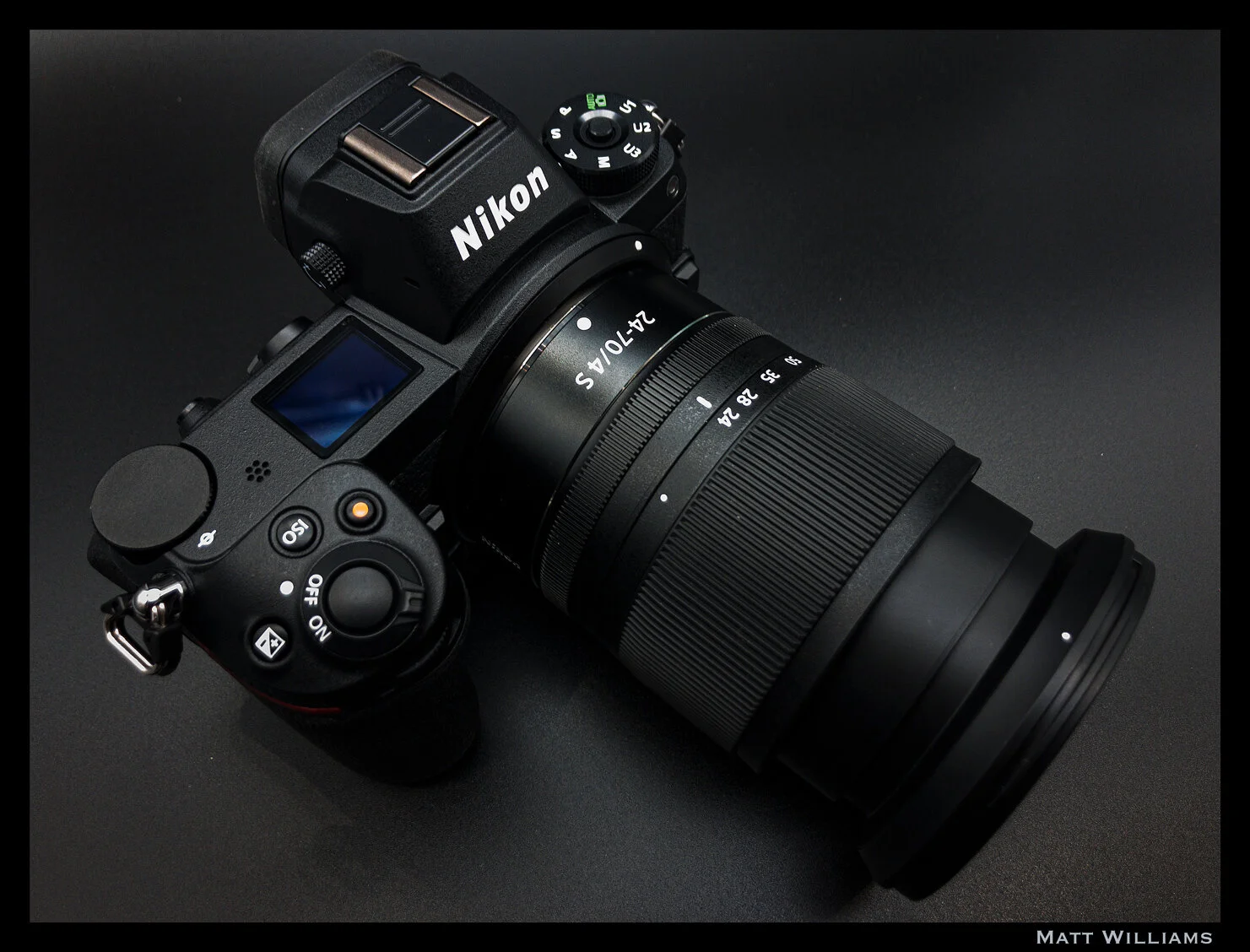
The first Z camera and lens I purchased. I was immensely impressed out of the gate with not only the camera but the 24-70/4 S. I wish more companies made small f/4 zooms like this and paired them in kits.
I’ve shot Nikon as my primary system since I left Canon behind in 2012. I’ve owned and used cameras from, as far as I can tell, every current manufacturer save Phase One. Some stuck with me longer than others – I have pretty limited experience with Pentax DSLRs, for example. I’ve never been a brand loyalist in any sense; the idea of that is just silly no matter how you look at it. Obviously, there is a form of “sunk cost loyalty” once you’ve invested in gear. Leap frogging from one system to another because so-and-so has this summer’s best [insert whatever specification] is solely in the realm of spec-sheet chasing hobbyists, not that of a working photographer.
Of course, there come times – especially after many years – where you find your priorities, needs, or preferences have shifted, as has the camera and photography landscape. I continued using DSLRs as my primary bodies until Nikon released the Z series because, well, I simply didn’t get along with Sony bodies (I’ve probably owned and eventually sold more models of Sony than any other company – my first mirrorless camera was actually a Sony).
Despite the subject of this post, I still view the Nikon Z cameras as the absolute best all-around system on the market. They are handily the best ergonomically, with the Panasonic S series a close second, though at the expense of portability. Their sensor IQ is unsurpassed (though certainly matched) by anything below medium format. Their lens lineup is second to none in quality* and second only to Canon for overall selection if you include native adapters. In my opinion, their mirrorless lens system is absolutely brilliant: benchmark image quality along with their laudable decision to skip f/1.4 lenses and put everything into f/1.8 primes. And I won’t get started on the mind-blowing performance of lenses like the 16-50/3.5-6.3, 24-50/4-6.3, and 24-200/4-6.3.
Nikon’s phenomenal 16-50/3.5-6.3 DX kit zoom. Probably the best sub-$500 kit zoom I have ever used. Pairs great with the Z7 too, giving you the same 20MP resolution as the Z50.
*To be clear here: Nikon, Canon, Sony, Panasonic… they all make amazing full-frame mirrorless lenses. But I see Nikon as having the overall best line-up when you consider image quality, size, price, options, and build quality. They went the right direction with affordable pro-level f/1.8 primes, great f/2.8 and compact f/4 zooms, and some absurdly good budget zooms (that’s where the “options” part comes in). Panasonic is doing something similar (20-60, 70-300/4.5-5.6, 70-200/2.8 and f/4, and now pro-level f/1.8 primes), but they lack the smaller options of Nikon (e.g. 24-50 and 16-50 pancakes) or the more affordable options (20-60 being an exception). Sony, lately, has very much impressed me with their compact f/1.4 GM primes, the 28-60, the newest G zoom lenses, etc. But… Sony’s lenses as a whole are not at the same level; many of their earlier lenses range from average to downright awful (most of their APS-C lenses are simply ok, often pretty poor). Even a number of their early Zeiss-badged lenses were quite poor (24-70/4 ZA). Lately, though, they’ve been killing it and of course they do have the largest ecosystem available… especially including third-party options.
Creative Commons License, Wikimedia Commons
Canon opted to kick off their full-frame mirrorless line by releasing two subpar bodies (EOS R and Rp) alongside ultra-fast, expensive, top-of-the-line glass (the 28-70/2 has to be commended, though – what an achievement). Yes, Nikon did this with the Noct-Nikkor f/0.95. What they didn’t do, however, is release two 85/1.2 lenses before they had a remotely affordable f/1.8 version. Canon decided to put resources into niche lenses like 600/800mm f/11 primes before a single f/4 wide angle zoom, a 50mm lens that isn’t dirt-cheap sub $200 or ultra-expensive over $2000, or a single prime lens below 35mm. I just don’t get it at all – and before I settled on what would end up being my first foray into another system, I kept coming back to Canon only to be immediately reminded why we haven’t gotten along in a decade.
*Canon, and sometimes other manufacturers, seems to think that professionals only use fast or ultra-fast glass. All you need to do is look at the popularity of Nikon’s 14-30/4, Sony’s 12-24/4, or Canon’s own 17-40/4L lens to see how much nonsense that is. These lenses are popular because they’re affordable, they’re all many people need, and they’re much smaller than faster f/2.8 alternatives. The same goes for f/1.2 primes. I have zero issue with the faster lenses being released – a 14-24 (or similar range), 24-70, and 70-200 at f/2.8 is a widely popular trio. F/1.2 primes are popular. It’s the apparent way Canon prioritized their lens releases that left me baffled, along with the release of legitimately unimpressive and poorly designed bodies out of the gate – bodies which screamed enthusiast but only had very expensive lenses to pair with. I’m sure the 28-70/2 is amazing, but let’s be honest… how many people bought it? I see it is a kind of halo product (like the Noct-Nikkor), except that Canon has continued the trend to this day – though they have tossed a few affordable lenses out here and there.
Again, they still don’t have a single prime lens below 35mm. That’s just plain damn strange.
I have to applaud Panasonic – I nearly went with their system to begin with. After using the S1, 20-60, and 24-105 lenses not too long ago (on rental for a job), I came away extremely impressed. The ergonomics are definitely the most “Nikon-like” (button/control placement, menus, overall design) and they just make sense. I found this true of the Panasonic G9 as well (the S1 is basically a leveled up G9). The lenses are very impressive. And it probably goes without saying, but no one comes close to Panasonic on the full-frame hybrid video front.
Panasonic S1 w/ 24-105/4 OIS
Creative Commons License, Wikimedia Commons
Sony. Boy oh boy. My first mirrorless camera was the a6000, not too long after it was released. I used it alongside my Nikon gear and I loved it at the time. Then I started doing work repairing cameras (and lenses) and, despite most of that work being on 35mm or medium format film cameras, over time I was able to use many (and I mean MANY) digital cameras. I eventually got the a6300, only to have Sony give those us of who bought it the finger when they released the a6500 eight months later. I even shot a few scenes for a ten-episode show with the a6300. I’ve also owned the a7, a7 II, a7R II, a7S II, a few RX100 models, and the RX10 Mark II (which I quite liked) – I’ve used, but not owned, the a7 III and a7S III.
There are many reasons why the first and second-gen Sony FF cameras aren’t great – I don’t think anyone would dispute that. They really came into their game with the third gen models. But every time I tried one, I just ended up missing my DSLR. For many reasons.
Things have changed, though. I no longer see any advantage to DSLRs; EVFs finally matured to the point where they’re simply transparent. With a nice EVF, I’m never actively aware that I’m looking at a digital display. Mirrorless autofocus has significantly improved, from tracking to new features like eye-AF. Lenses have improved. General technology itself has improved – once Canon and Nikon finally put all their resources into mirrorless, we’re seeing great improvements with every new release no matter whose name is on the front.
Sony a7R III. One of the cameras I considered, especially appealing given it can be found used for under $1800.
Photo by Ke Chun Yuan. Creative Commons License. Find the original here.
Sony was one of the top two most attractive options for me to move to – mainly because of their prevailing technology (especially autofocus, though others have caught or nearly caught up, especially Canon) and their massive native lens selection. Adapters like Nikon’s FTZ work wonderfully and are great to use while switching over or to fill gaps in the lens lineup, but I’d still rather have a native-mount lens any time. As I mentioned, I really love not only the types of lenses Sony has decided to release recently, but also how fantastic they are. The 28-60 compact zoom is identical to Nikon’s 24-50 in approach, just opting for a bit more on one end at the expense of the other. And both are truly excellent optics. Their 24/35/135 1.4 GM, 50/1.2 GM, and 20/35/85 1.8 G lenses are very good and surprisingly compact pieces of engineering. I’ve really loved the recent 70-350 G and the older 24-105 and 12-24 G zooms: stellar image quality but still affordable. Most of all, while I have not used them yet, I bend the knee to Sony for releasing the 24/2.8 and 40/50 2.5 G lenses. I used to beg Zeiss for f/2.5 or 2.8 versions of their Otus lenses – which they basically had in the Loxia line, but nothing for any other mount, let alone DSLRs. Nikon should be doing something similar with the upcoming 28 and 40mm pancakes, but I’d love to see a 24, 35, and 50 as well (Sony already has some great 35mm pancake options with the 35/2.8 Zeiss, Samyang 35/2.8, and the slightly larger Tamron 35/2.8).
So, with all my love for Nikon, why did I start to look elsewhere? It’s really a culmination of several factors that ended up compounding on themselves. This past year, with *flails arms* everything that’s happened, resulted in the need to do some gear downsizing. It also forced me to look ahead at where I want to go and be professionally and think about what I really need to do that and what is the most economical way to get there, even if some sacrifices have to be made. There’s also the elephant in the room, at least if you read pretty much any photography website: Nikon has not been doing well financially. They’ve closed a number of factories and significantly trimmed down their employ across the globe. In my logical brain, I know that these decisions are likely to help them succeed in the long run (reducing operating expenses generally does that). But the non-logical part of me can’t help but be worried.
Fujifilm X-Pro3. I actually loved this camera when I played with it. But, its price, lack of IBIS + grip support, and several other factors make it unsuitable when you’re trying to keep costs down, since it can’t be my main camera.
Creative Commons license, Wikiemedia Commons.
I don’t really buy into the idea that Nikon is doomed to fail – in fact, I think that’s very unlikely. However, it is true that they aren’t doing as well as they had hoped, nor as well as others. It’s also true that, unlike say… Sony or Panasonic or Canon… they don’t have other departments to lean on. Pentax is a fantastic example: the only reason they manage to keep releasing cameras and lenses is because their imaging department is a miniscule part of the company’s revenue. Off the top of my head, only Nikon and Leica are not in such a position. But Leica will continue forward as usual because they’re a niche, luxury brand with a comparatively small workforce and they don’t need to worry about someone else undercutting their prices or stealing their customer base. They also make cinema lenses and probably microscopes and whatever other stuff.
Obviously, I’d be lying if I said the Olympus situation didn’t knock a bit more fear into me as well. Which will turn out to be pretty ironic in part two of this.
If Nikon’s demise was truly my only concern, I wouldn’t even be writing this. I’m not selling my gear and switching brands over something like that. Hell, even if it happened, worst case scenario is that I’d sell my gear a few years down the road and still be able to switch systems just fine. I think it’s important to step back and not take for granted that most people, including myself, could do 99% of everything we want to with the lenses/cameras Nikon has already released (if you include F-mount via FTZ adapter for Z bodies).
However, like I mentioned, I was forced to 1) sell off some my lesser used gear (45mm PC-E Micro, Zeiss 2/50 Makro ZF.2 and Nikon 135/2 DC, just to name a few) and 2) think critically about the next 5+ years and what I want to do and what I would need to do it. There’s no longer leeway for hoarding expensive gear I only use every so often. Long story short, I’m working to branch out into a couple relatively uncharted waters for income work, while also focusing on some personal projects of mine. There’s a lot more to it than that, but that’s the basic gist.
So, where did I land with a new system? The answer is Fujifilm.
However, that’s far from the end of the story.
The rest of which will be in Part Two, coming soon.
Current State of Sensor Formats
**Note: 99% of this was written before the unfortunate announcement of Olympus selling its camera division. So, that may change or at least affect some of what I’ve opined here.**
Once upon a time, we would see major innovations in sensor technology every other year or so: the shift from CCD to CMOS. The release of the D3 and D700 which, while also being around the time of the “full-frame” sensor explosion*, represented a significant boost in dynamic range, speed, and high ISO capability. There was the advent of full-frame 1080 24p video with the 5D Mark II – arguably the single most influential event in indie cinema history (along with the Arri Alexa). Then came the megapixel race: Nikon released the D800, bumping us past (for 35mm or smaller formats) the 20-24 megapixel ceiling; Sony soon followed with the same resolution in the a7R and the race was on.
**Note: 99% of this was written before the unfortunate announcement of Olympus selling its camera division. So, that affects some of what I’ve opined here and probably answers a few questions about the recent trends in the camera industry that I bring up - namely, how larger sensors have caught up to or surpassed the advantages of smaller formats.**
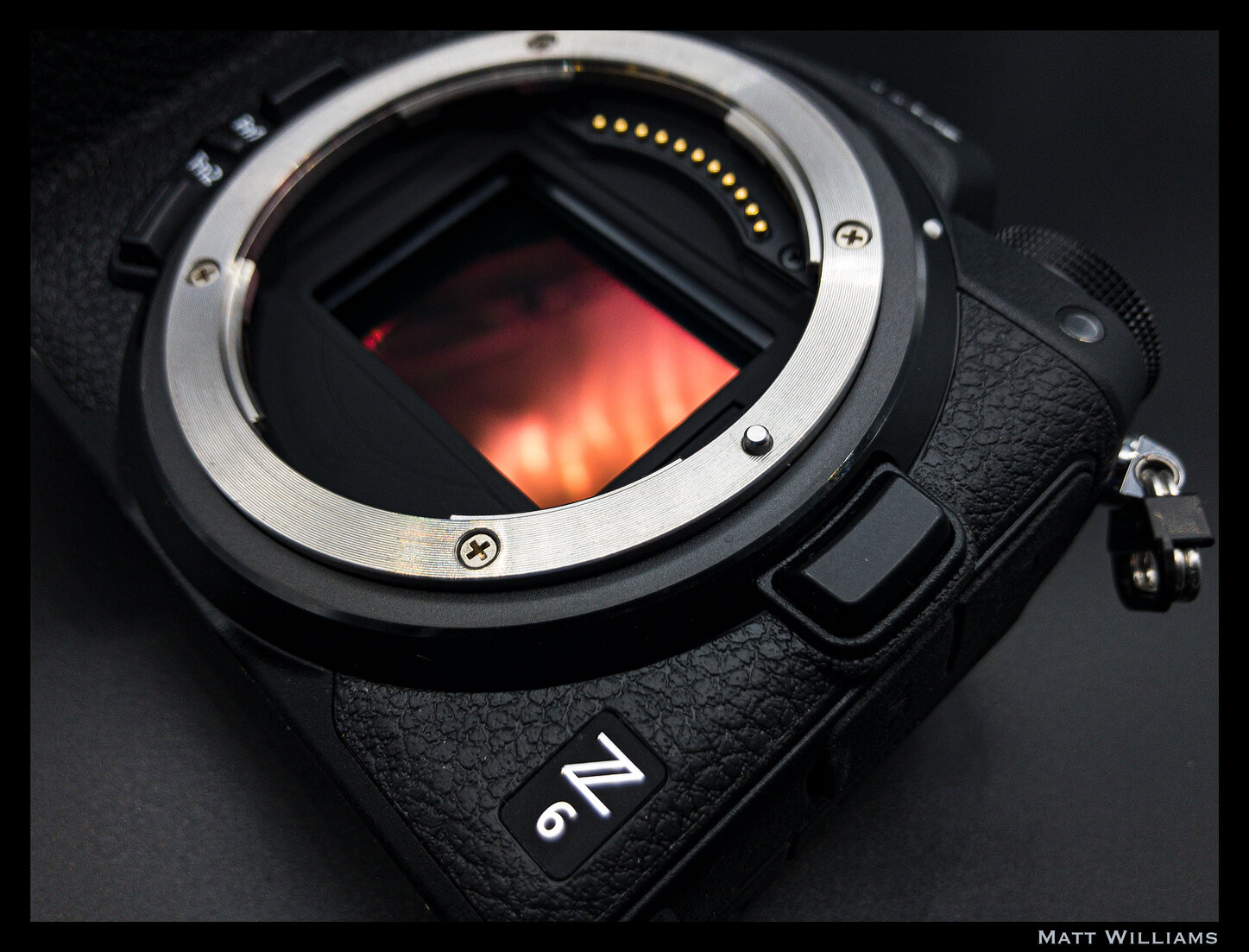
Nikon Z6 - Full Frame Sensor. Photo taken with an iPhone 8 in LR Mobile.
Once upon a time, we would see major innovations in sensor technology every other year or so: the shift from CCD to CMOS. The release of the D3 and D700 which, while also being around the time of the “full-frame” sensor explosion*, represented a significant boost in dynamic range, speed, and high ISO capability. There was the advent of full-frame 1080 24p video with the 5D Mark II – arguably the single most influential event in indie cinema history (along with the Arri Alexa and RED One). Then came the megapixel race: Nikon released the D800, bumping us past (for 35mm or smaller formats) the 20-24 megapixel ceiling; Sony soon followed with the same resolution in the a7R and the race was on.
*The first full-frame digital camera was the Contax N released in 2002. Canon introduced the full-frame 1Ds later in 2002 and Kodak unveiled the DCS Pro 14n in 2003. Canon then gave the world the 1Ds Mark II and 5D in 2004/2005, which saw significant IQ boosts over prior models. However, it wasn’t until Nikon released the D3 and Canon the 5D Mark II that the market began to shift toward full-frame as the digital standard.
Just a few years after the Nikon D800 and Sony a7R, Canon threw down a trump card with the 5DS/5DSR and their 50.6MP sensor. Sony followed months later with the 42MP a7RII. This was the peak of the resolution race – in fact, Canon wouldn’t lose the title until over four years later, upon the recent release of the a7R IV. Instead, camera manufacturers shifted focus to other technology: BSI sensors, blazingly fast frame rates, silent electronic modes that could compete with mechanical shutters, advanced autofocus features like eye AF, IBIS, improved EVFs, etc. We also saw an explosion of new lenses with seemingly everyone trying to one-up the others with sharper, faster, aberration free optical designs. Lenses became larger and heavier while cameras became smaller and lighter. Recently, this trend seems to have reversed itself: manufacturers realized there is such a thing as too small for a camera and engineers have worked toward a nice middle ground with smaller, slower lenses** that retained the similarly impeccable IQ (and succeeding, along with a higher price tag to match).
*The use of in-camera software to correct for various optical deficiencies – vignetting, chromatic aberration, distortion – has also been pivotal in the reduction of bulky lens designs.
While it may not seem like it, there’s been a massive shift in the camera world just in the past two years. Though unlike what we saw in the mid to late 2000s, it has been less of a shake-up and more of a subtle, natural evolution. Specifically, I’m referring to the disparateness between formats.
Not too long ago, it looked something like this:
Smartphone: terrible, usable only for what I’d describe as non-photography photographs; pictures to document something where IQ is irrelevant.
Compacts (ranging in size usually up to 1”): acceptable to very good image quality, particularly at or near base ISO. Many had impressive zoom ranges, some had fixed prime lenses (or limited ~24-70mm range) and large sensors. Many of these are still extremely good cameras (see: Ricoh GR series, Fujifilm X100 series, Panasonic LX100). Most of the compacts (excluding the large sensor outliers) hit a threshold of acceptable quality somewhere between ISO 400 and ~1600, depending on their sensor size and your standards.
Micro Four Thirds: A big leap from the 1” or smaller sensors, especially being the smallest format with interchangeable lenses.* Micro 4/3 built their reputation with a number of landmarks in imaging tech, starting in the late 2000s. They were the first mirrorless ILCs**; they matured and standardized the implementation of in-body sensor-based image stabilization (originally developed by Konica-Minolta); they cultivated the first truly thorough mirrorless lens line; and, due to some very wise choices with their mount, they had the distinct advantage of tiny, cheap, but optically excellent lenses.
*I’m ignoring the Nikon 1 and Pentax Q series because neither was ever a fully realized or mature system.
**Technically, the Epson R-D1 was the first MILC followed by the Leica M8, but for obvious reasons we’re restricting this to cameras with autofocus, live-view, and zoom/telephoto lenses.
APS-C / APS-H: Before full-frame technology matured, these were the standard sensors in professional and prosumer camera bodies. APS-H had a ~1.3x crop factor compared to the ~1.5x (Nikon) or ~1.6x (Canon) APS-C crop factor. It was used primarily by Kodak in a number of models, Canon in their 1D series, and Leica in the M8/8.2. It was eventually phased out in favor of the (slightly) smaller APS-C format – likely because the performance difference was negligible, improvements in APS-C were advancing faster, and APS-H required the use of full-frame lenses since lines like Canon’s EF-S couldn’t cover the larger sensor. It made no financial or technical sense for Canon to maintain three separate sensor-size lines at the same time (FF in the 1Ds and 5D series, APS-H in the 1D series, and APS-C in the Rebel line). So, Canon dropped it, Kodak dinosaured out of the digital camera market (though continued to make sensors), and Leica upgraded to full-frame in the M line.
Note: APS-H is still used by Sigma in their sd Quattro H body. As far as I know, this is the only camera currently in production to use an APS-H sensor.
Nikon Z50 - APS-C Sensor. Photo taken with Nikon Z6 & Nikkor 24-70/4 S
And thus, APS-C became the gold-standard for prosumer and consumer bodies. Advantages were plentiful over the larger 135 size: greater sensor yield (meaning cheaper to produce), smaller bodies, and smaller lenses – all while retaining good IQ and decent ISO performance. It was an excellent compromise between quality, cost, and size. Sony’s 2014 APS-C a6000 ushered in a mass appeal of mirrorless cameras among general consumers – it was the best-selling mirrorless camera of all time and the best-selling camera over $500 year after year. In fact, it still regularly remains toward the top. It may well be the most successful and profitable MILC ever released.
35mm/135 aka “Full Frame”: Since roughly 2007/2008, this has essentially been the standard against which all other formats are compared, right down to field of view or “crop factors” (part of this is of course inherited from the days of film). Full frame yields the best sheer IQ when you consider factors like size, weight, cost, flexibility of shooting, etc. Yes, you will have greater potential for superior image quality from a medium format system, but even today MF is still extremely limited by price and lens selection. And prior to the last couple years (i.e. the release of Fuji’s GFX and Hasselblad’s X1D), there was zero question about which format had the greater price-to-performance ratio, not to mention other factors like size/weight.
Medium Format (specifically 44x33): Until recently, it was very limited in application, but undoubtedly the best image quality under ideal circumstances. Improvements in technology were – and still are – slow to progress; the 50MP sensor used today (also the first CMOS medium format sensor) dates to late 2013 or early 2014. Earlier CCD based cameras like the Hasselblad H4D and Pentax 645D had incredible acuity, color, and tonal transitions at base ISO. But, once you pushed beyond ISO 400 or so, such advantages rapidly, and non-linearly, dissipated. Cameras like the Nikon D800/E existed at the same time and easily won out on dynamic range, color, and noise at anything above the lowest sensitivities. They also had significantly more latitude for hand-held photography, anything requiring a smaller footprint, fast glass, or access to a library of specialized lenses (e.g. tilt shift, super macros). And, of course, they were leagues more affordable.
Ok, let’s travel to 2017/2018.
Sensor technology tends to trickle upward; BSI (backside illumination) was originally developed by Sony with their Exmor R and used in some Sony phones as well as the iPhone 4s. It wasn’t until five or so years later that the technology appeared in a larger format sensor (Samsung’s APS-C NX1) and subsequently moved upward to the Sony a7RII and recently to medium-format with the GFX 100 (but oddly never to M4/3). Sensor-based image stabilization began with Konica Minolta’s Dimage A1 (2/3” sensor) onward up to Olympus (4/3 sensor) with the E-510, and now in 44x33 with the GFX 100.
The upshot of this that while under optimal conditions a larger sensor will always produce a higher quality image, there has almost always been various equalizers in the mix to close the gap (even if not fully so) under specific circumstances.
With the release of the Olympus E-M5 in early 2012, there now existed cameras with incredible in-body stabilization that could fit in a jacket pocket. But their sensors were 1/4 the size of full-frame. Given equivalent sensor technology, this gave full-frame a two-stop advantage. But it wasn’t really that simple: with 4-5 stops of image stabilization in the E-M5 versus zero in any full-frame camera (at the time), the Olympus could more than close the gap in lower light. Where the Nikon may require ISO 3200 to achieve a sufficiently fast shutter speed, the E-M5 may be capable of shooting at ISO 200 – all in a much smaller package to boot. There are limitations to this, of course: drop too low with your shutter and while you may be able to get a sharp image of a static subject, you may not for people or other moving objects. Conversely, at base ISO on a tripod, the Nikon wipes the floor with the Olympus.
Something odd has transpired particularly in the last two years or so. 2018 saw the release of Canon’s EOS R and Nikon’s Z6 & Z7, the first full-frame mirrorless cameras from either company – in fact, from any company other than Sony and the far more niche Leica. Looking specifically at the Nikon Z, we now had a full-frame, in-body stabilized sensor in a body the size of an Olympus E-M1. We could now shoot 50mm at 1/8 of a second with ease – even lower if we accept a dip in hit-rate. The Olympus still has better stabilization; physically speaking, on an equal playing field, a smaller (read: lesser mass) sensor will always be easier to move.
Of course, for a given field of view, aperture, and build quality, micro 4/3 lenses will always be smaller. You cannot get a full-frame 28/2.5 with autofocus at the same size of the Panasonic 14/2.5. But, since our playing field has been (mostly) leveled via stabilization, the other option is faster glass, which also applies if matching DOF is important to you*. Then we have something like this: Nikon Z with 24-70/4 S and Olympus E-M1 with a Panasonic 12-35/2.8. But now, we are once again back to almost exactly the same size and the Panasonic lens is still at a one-stop DOF disadvantage. These are simple rules of physics and the reason that lenses like the Fujinon XF 200/2 are gargantuan behemoths – they’re trying to match a 300/2.8 and thus ends up being about the same size and weight (and often, more expensive).
*DOF equivalency is a big, dumb topic of debate in internet forums and comments sections. Apparently, everyone on the internet shoots wide-open portraits or pictures of fence posts or something. If shallow DOF is that important to you, use full frame. It’s significantly cheaper and with more options. Alternatively, you could try to work past your obsession with bokeh and obliterating any sort of context behind or in front of your subject, but that’s your prerogative. Ironically, the same people who tear their hair out over f/1.4 lenses vs. f/1.8 also chase resolution, which is entirely wasted if most of your frame is out of focus.
Beyond this, we now have cameras like the Hasselblad X1D and Fujifilm GFX 50R that are approximately the same size as the Nikon Z, E-M1, or Panasonic G9 lines. With the exception of Sony’s a7/a9 line, the ubiquity of large format mirrorless cameras didn’t exist even just three years ago. Now it’s become not only commonplace but is clearly the direction of the future (nothing points to this more than Canon ceasing development of new EF lenses – I expect Nikon has or will do likewise). It’s quite possible that cameras like the Nikon D6 and Canon 1DX Mark III will be the last pro-DSLRs produced by those companies – consider the four or so year development time between new models… what will mirrorless technology in 2024 look like? My guess is the few remaining benefits of DSLRs will have been eclipsed by then, especially considering that depending on who you ask, they already have been. And, of course, I’d be remiss if I didn’t point out both Panasonic and Sigma’s entry into the full-frame mirrorless game – also both within the last two years.
Another issue is that prices have constricted inward; the lower end has gone up (a Fujifilm X-T4 is $1700, an E-M1 Mark III is $1800) and the higher end has dropped (a Sony a7III is $2000, a Z6 is $1800). Mirrorless medium format can be had for less than pro body full-frame. You can acquire mirrorless full-frame for $1,000 or less (Canon Rp, Sony a7II) – the same as an E-M5 Mark III and less than a Sony RX100 VII!
All of this is to say that while the capabilities of larger formats have largely caught up to the advantages of smaller formats in many ways, the price has seemingly done the opposite. This isn’t at all intended to say that Micro 4/3 or APS-C don’t still have advantages; you won’t find full-frame lenses with the same size, price, and quality as many of the Olympus of Panasonic lenses. This especially applies on the telephoto end (where I think M4/3 still retains a serious and very legitimate advantage); there is nothing in APS-C/FF with the same reach, size, or price that compares to the Olympus 75-300 or Panasonic 100-300. And there are very few larger sensor cameras that can do the frame rates of a Panasonic G9 or E-M1X in C-AF (only the Sony a9/a9II and Canon 1DX Mark III come to mind) and none can equal the speed in S-AF. Plus, all of this is to say nothing of the built-in features Panasonic and especially Olympus have developed over the years – arguably the closest thing to what we’d call computational photography in ILC cameras today.
A lot of what we’re seeing here is due to a natural paradigm shift in the camera world that, in large part, was brought on by the mass adoption of smartphones. More photos are taken and shared today than ever before in history – but unlike the 2000s or earlier, very few “regular” people even own a dedicated stills camera. The market caters mostly to amateurs, hobbyists, and professionals now – not mom and dad.
To close, I’ll simply say that this is a very interesting time in photography. Image quality and features are more than we could have dreamed of five years ago and our options are vast and expanding by the day (the Fujifilm GFX 50R was recently discounted permanently to $3500). There’s a good deal of volatility and uncertainty thrown into the mix due to COVID-19; it’s made for some nice discounts and offers out there*, but is also doing some concerning damage financially speaking.
I, for one, will be very curious what the next year or two holds for us.
*Panasonic is giving free 2 year warranty extensions (for a total of 3 years) on all of their cameras and lenses purchased between now and March 31, 2021. Make sure to register online!
Ishimoto Blog:
Integer posuere erat a ante venenatis dapibus posuere velit aliquet. Fusce dapibus, tellus ac cursus commodo, tortor mauris condimentum nibh, ut fermentum massa justo sit amet risus.